

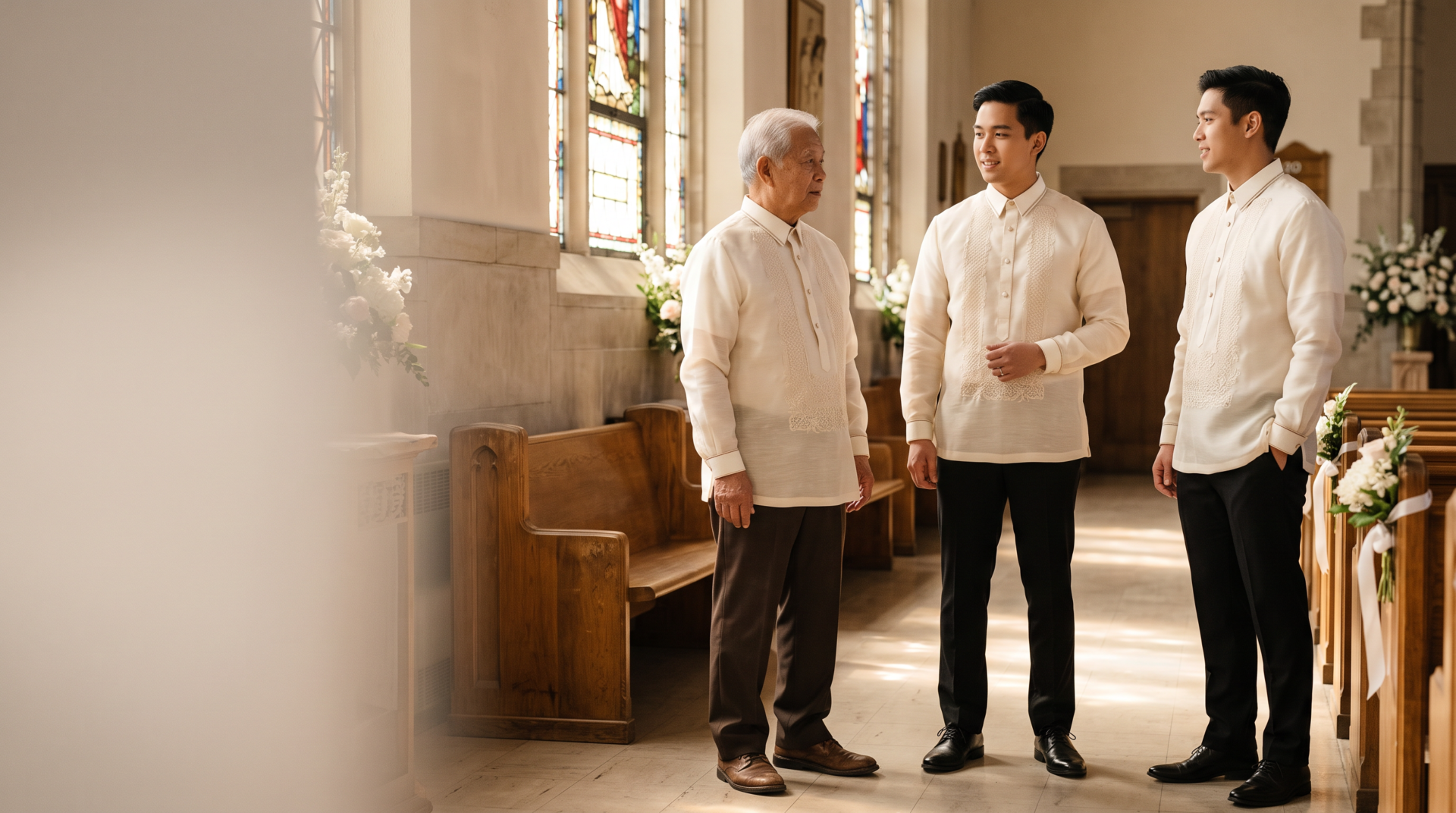
If you are searching for barong accessories, you are usually a few weeks away from a wedding, a baptism, or a milestone birthday, and you want to get the details right. The short answer is that a barong tagalog is worn with an undershirt, dark trousers, black leather shoes, and very little jewelry. Everything else is restraint.
This guide walks you through what to wear underneath, what to wear on your feet, and the small choices that separate a thoughtful outfit from a rushed one.
What do you actually wear under a barong tagalog?
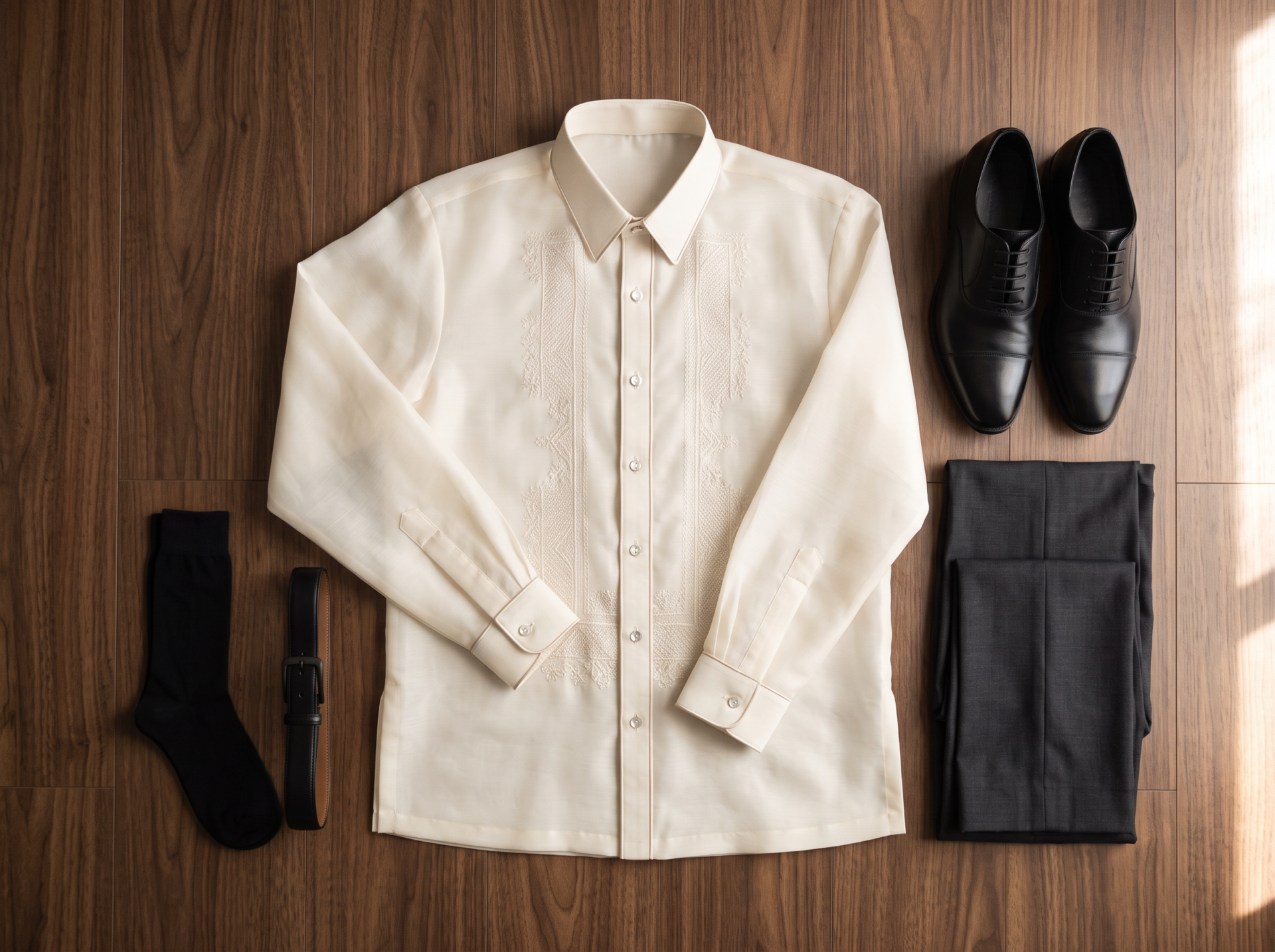
A barong tagalog is traditionally worn over a plain white undershirt called a chamisa de chino. It is a thin, lightweight tee with no visible logos, no pocket, and no printing that can show through the embroidery.
A crew neck is the standard. If your barong has a deeper opening at the collar, a V-neck undershirt keeps the cotton from peeking out. Either way, the undershirt should be clean white, not cream, not heather gray, and not the old one from the back of your drawer.
If you only take one thing from this section, take this. The undershirt is part of the outfit, not an afterthought. Buy a fresh one for the occasion.
What pants and shoes go with a barong?
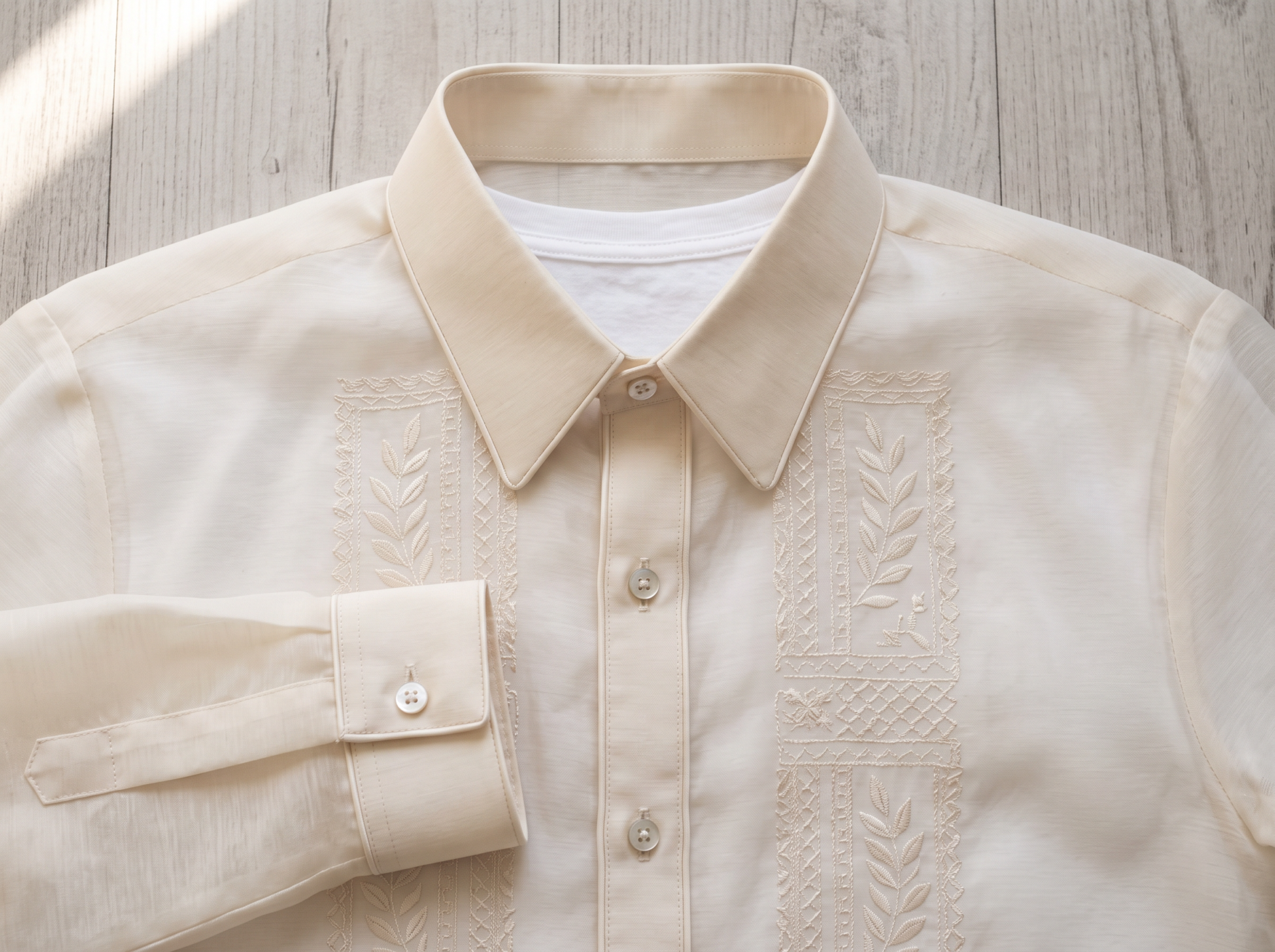
Black dress trousers are the default, and they work for every formal occasion a barong is appropriate for. Charcoal and very dark navy are acceptable at daytime events, especially weddings held outdoors. Pleated or flat front is a matter of personal preference and body type, not etiquette.
For shoes, wear plain black leather oxfords or cap toes. Loafers are acceptable at a garden wedding or a cocktail reception. Avoid brown shoes with a traditional barong, and avoid anything with heavy broguing or decorative stitching. The embroidery on the barong is the detail. Your shoes should not compete.
Socks are thin, black, and tall enough that no skin shows when you sit down. This is the kind of thing nobody notices until it is wrong.
Do you wear a belt, a tie, or cufflinks with a barong?
A thin black leather belt with a small, unpolished buckle is correct. The belt is functional, not decorative. If your trousers fit well and have side adjusters, you can skip the belt entirely.
You do not wear a necktie, a bow tie, or a pocket square with a barong tagalog. The garment is complete on its own, and adding Western formalwear accessories crosses signals. The same goes for a vest or a waistcoat. The barong is the top layer.
Cufflinks are the one exception. A traditional barong has French cuffs that require a cufflink or a button stud to close. Simple gold, silver, or mother of pearl designs are the safest. Save novelty cufflinks for a different kind of event. If the barong you chose has barrel cuffs with buttons already sewn on, you do not need cufflinks at all. Check your garment before you shop.
What about a watch, a ring, and other jewelry?
Keep jewelry quiet. A thin dress watch on a black or brown leather strap is appropriate. A wedding band is appropriate. A chain under the undershirt is fine because no one will see it.
What does not belong is a chunky sport watch, a rubber strap, a visible chain over the undershirt, or multiple rings on one hand. The barong is a formal garment with a long cultural history, and heavy jewelry pulls it toward something it is not.
Grooms sometimes ask about wearing a boutonniere. If the wedding coordinator has planned one, wear it on the left side, pinned through the fabric rather than through the embroidery. If it is not already planned, you do not need one.
How is a modern barong styled differently?
Shoppers searching for modern barong accessories are usually asking one of two things. Can I wear a slimmer cut, and can I pair it with something less traditional than a full suit of black trousers and oxfords.
The answer to both is yes, within reason. A modern barong tagalog often has a trimmer body, narrower sleeves, and a slightly shorter hem that sits closer to the hip than the mid-thigh. With a cut like that, a tapered black trouser and a sleek derby or loafer looks balanced. A chunky traditional shoe can look out of proportion.
For grooms who want a contemporary look, consider matching the trouser fabric to the wedding palette instead of defaulting to black. Dark olive, deep burgundy, and midnight blue all photograph well next to a cream or ivory barong. Keep the shoes black, keep the undershirt white, and let the trousers do the modernizing.
What does not change is the rule against neckties and pocket squares. A modern barong is still a barong.
Fit, fabric, and occasion
Fit is where most first-time barong wearers get caught out. Filipino sizing runs one step small compared to US sizing. If you normally wear a US large, you will likely need an XL in a barong sized by Philippine measurements. Check the size chart on the product page every time, because the step is not always the same across makers.
The barong should skim the body, not hug it. The hem traditionally falls somewhere between the top of the thigh and the mid-thigh, and the sleeves end at the wrist bone. If you are between sizes, size up. A barong that is slightly loose reads as elegant. A barong that is tight across the chest reads as borrowed.
On fabric, the main thing to know is that traditional barong fabrics are lightweight and sheer by design. That is why the undershirt matters so much. The sheerness is a feature, meant to show the embroidery against the skin and to keep you cool in a tropical climate. If you are attending a winter wedding in the United States, plan for a jacket or overcoat for the walk from the car, not a heavier barong.
For occasion, the general hierarchy runs like this. The most formal barong styles are reserved for the groom, the principal sponsors, and the fathers at a wedding, or for the guest of honor at a major milestone. Simpler styles work for guests, for office events, and for less formal gatherings like a baptism reception or a graduation dinner. Funerals call for a plain barong with minimal embroidery, worn with the same black trousers and black shoes you would wear otherwise.
A final word before you shop
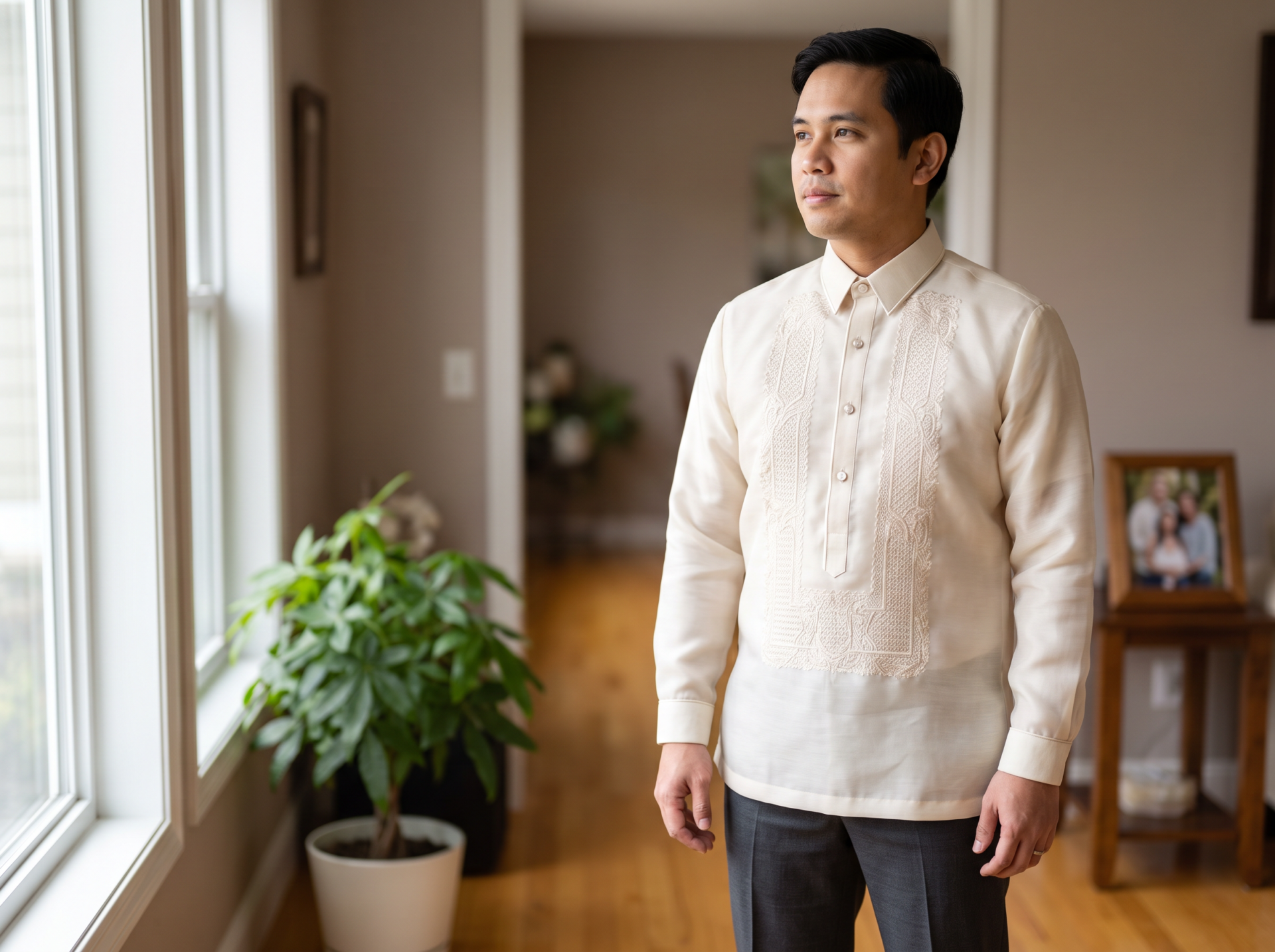
Barong accessories are not really about adding things. They are about choosing the few correct pieces and leaving the rest off. A fresh white undershirt, clean black trousers, polished black shoes, a simple watch, and your wedding band. That is the whole outfit.
When you are ready to choose the barong itself, our men’s collection is organized by occasion so you can start from the event rather than the garment. Browse the groom, ninong, and guest categories and work outward from there.
Further Reading: Complete Your Barong & Formalwear Look
Ready to choose your barong or compare fabrics, cuts, and sizing before your event? Explore these related guides and collections:
- Where to Buy a Barong in the USA: Ultimate Buyer Guide – Searching where to buy a Barong in the USA? Avoid sizing and shipping issues with our expert guide to authentic Barong Tagalog for men and women.
- Choosing the Perfect Barong Fabric for Filipino Formalwear – Organza, Jusilyn, cocoon or cotton? How to choose a barong fabric by occasion, climate and fit, plus what piña and jusi mean (we don’t sell those).
- How to Find the Best Barong Styles: Complete Guide – Compare classic and modern barong styles. Learn how to choose the right cut, sleeve length, fabric, and US fit for weddings, baptisms, and formal events.
- Shop Men’s Barong Tagalog by Occasion – Browse hand-embroidered formal and modern barongs ready to ship within the United States.