
Four fabrics, four roles
The Fabric Guide
Every barong fabric photographs differently, hangs differently, and carries a different weight of formality. We carry four: organza, cocoon, Jusilyn and cotton, all hand-embroidered by artisans in the Philippines. We don’t sell piña or jusi.
Quick chooser: Wedding (groom) → Cocoon. Wedding (entourage) → Organza or Jusilyn. Office / casual → Cotton.
Crisp · breathable · the modern wedding standard
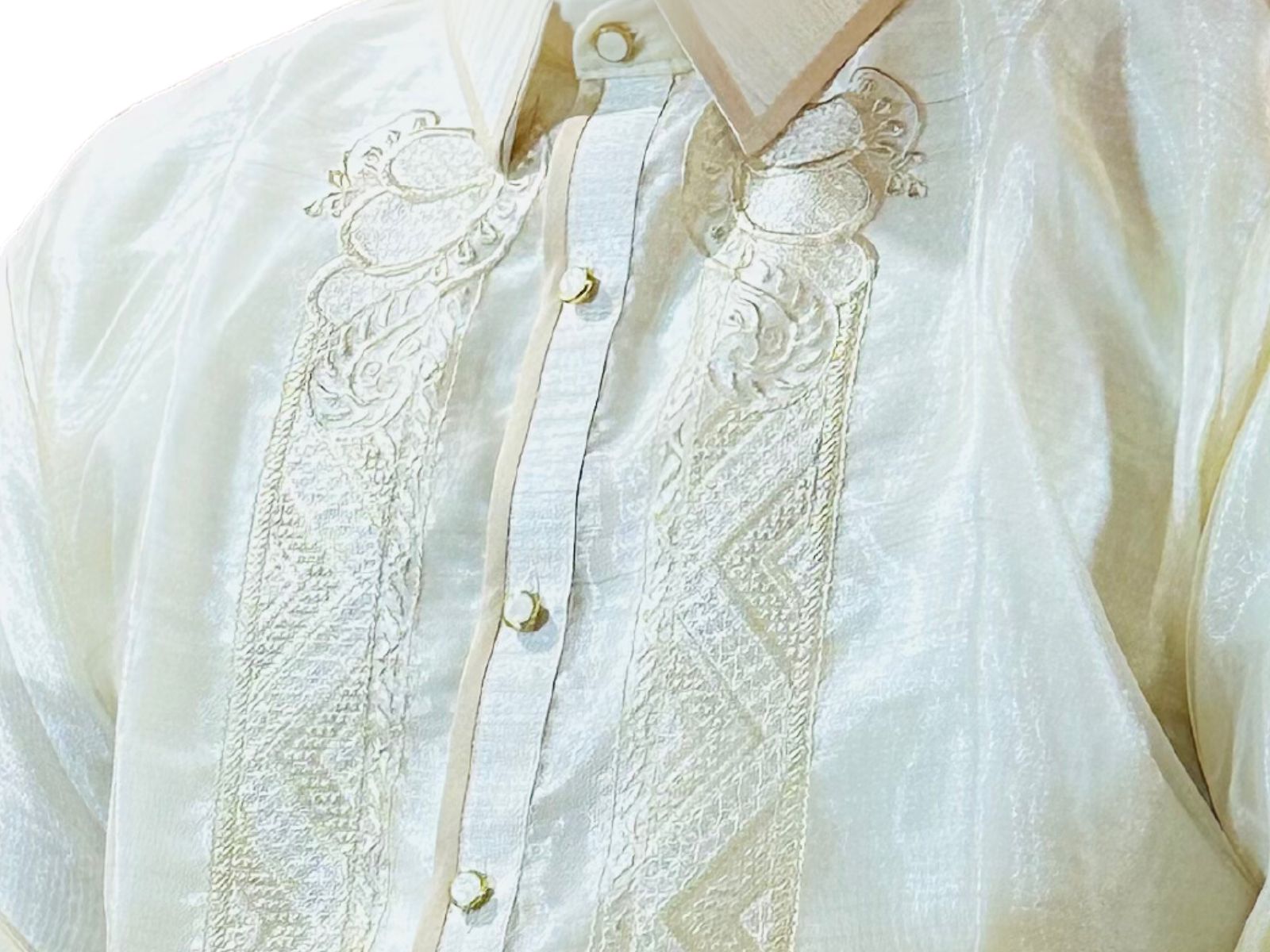
Organza
Organza is the everyday formal fabric of the Filipino wardrobe: the one you’ll see on most groomsmen at most weddings, in every shade from ivory and champagne to deep wine. It’s a tight plain weave, finished to hold its shape through heat, embroidery and a full day of photographs. Organza was historically a silk weave; the organza on our barongs is polyester, which gives it the structure, color stability and easy care that silk organza never had. On our men’s barongs it’s double-layered, so it’s fully opaque.
That shift is part of how the barong has stayed wearable in the U.S. Silk organza wrinkles deeply, yellows in sunlight and needs delicate care. Polyester organza photographs cleanly under both daylight and reception light, takes hand embroidery beautifully, and hangs the same way after the third wear as it did on the first. When you see a Filipino wedding party in coordinated, crisp barongs in a magazine photo, that’s almost certainly organza of this kind.
For the entourage, organza is the practical default. The weave reads “Filipino formal” across photo light from harsh midday to candlelit reception, and the price point lets you order matched pieces for the full party without breaking the budget. Pair it with the groom in cocoon for the visual hierarchy that reads correctly in every shot.
Drape: sharp, holds the line
Weight: light
Breathability: high
Formality: wedding-grade
Care: hand wash and hang dry
Best for: outdoor + warm-climate weddings, large entourages
When to choose it. If the wedding is outdoors, in a warm climate, or has 4+ pieces in the entourage — organza is the default. Many grooms also choose organza when the wedding is informal or beach-side; it photographs lighter and reads less ceremonial than cocoon, which is exactly the right register for a daytime garden ceremony.
Textured · soft lustre · the groom’s fabric
Cocoon
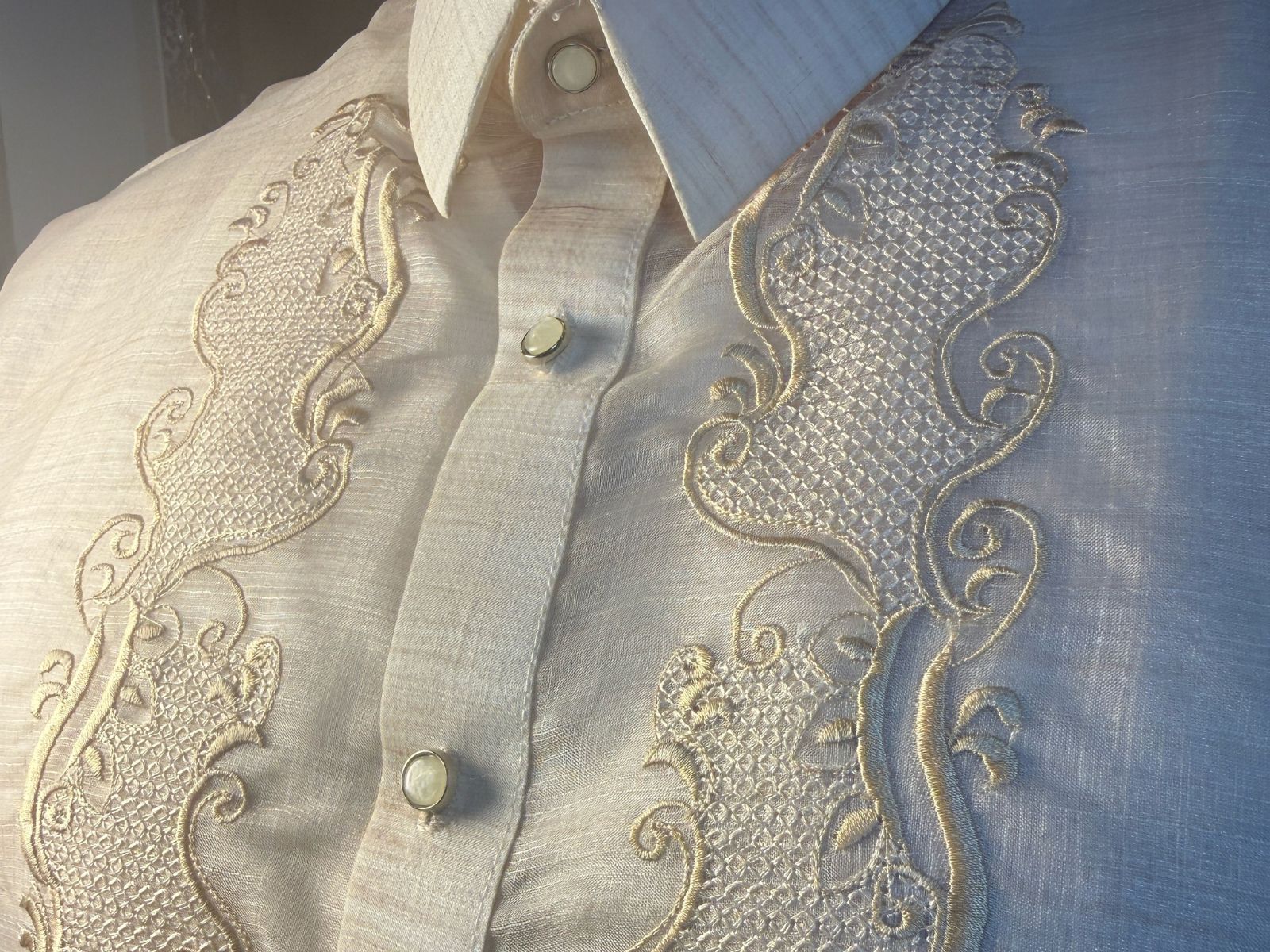
Cocoon is the most textured fabric we carry. It’s a single layer with a slubby crosshatch weave you can see clearly up close, and a soft, dry lustre rather than a shine. It’s lightly translucent, so a plain white camisa de chino underneath shows through faintly, which is the traditional barong look. Among Filipino-American families it has become a favorite for the groom whenever the rest of the party is in something smoother.
Our cocoon barong is a warm ivory with tone-on-tone cream embroidery, so the design reads as texture rather than contrast, finished with pearl buttons set in a slim metal rim. It’s made to be the quiet, rich piece in the wedding photo rather than a bold color statement.
For the groom’s role specifically, cocoon does work that detail alone can’t. Its texture catches light differently from smooth organza, so even in a wide group photo the eye lands on the groom. Pair it with an organza entourage and the wedding photo composes itself. Outside of weddings, cocoon is a good pick for an anniversary portrait, a baptism godfather role, or any single high-stakes photo.
Drape: structured, defined
Weight: heavy (for a barong)
Breathability: moderate
Formality: ceremonial
Care: hand wash and hang dry
Best for: grooms, fathers of the bride, formal portraits
When to choose it. The standard call for the groom whenever the entourage is in another fabric. Also: father of the bride, principal sponsors (ninong), or anyone whose presence in the wedding photo needs to read with the same gravity as the groom.
Light · entourage-ready · lightly sheer
Jusilyn
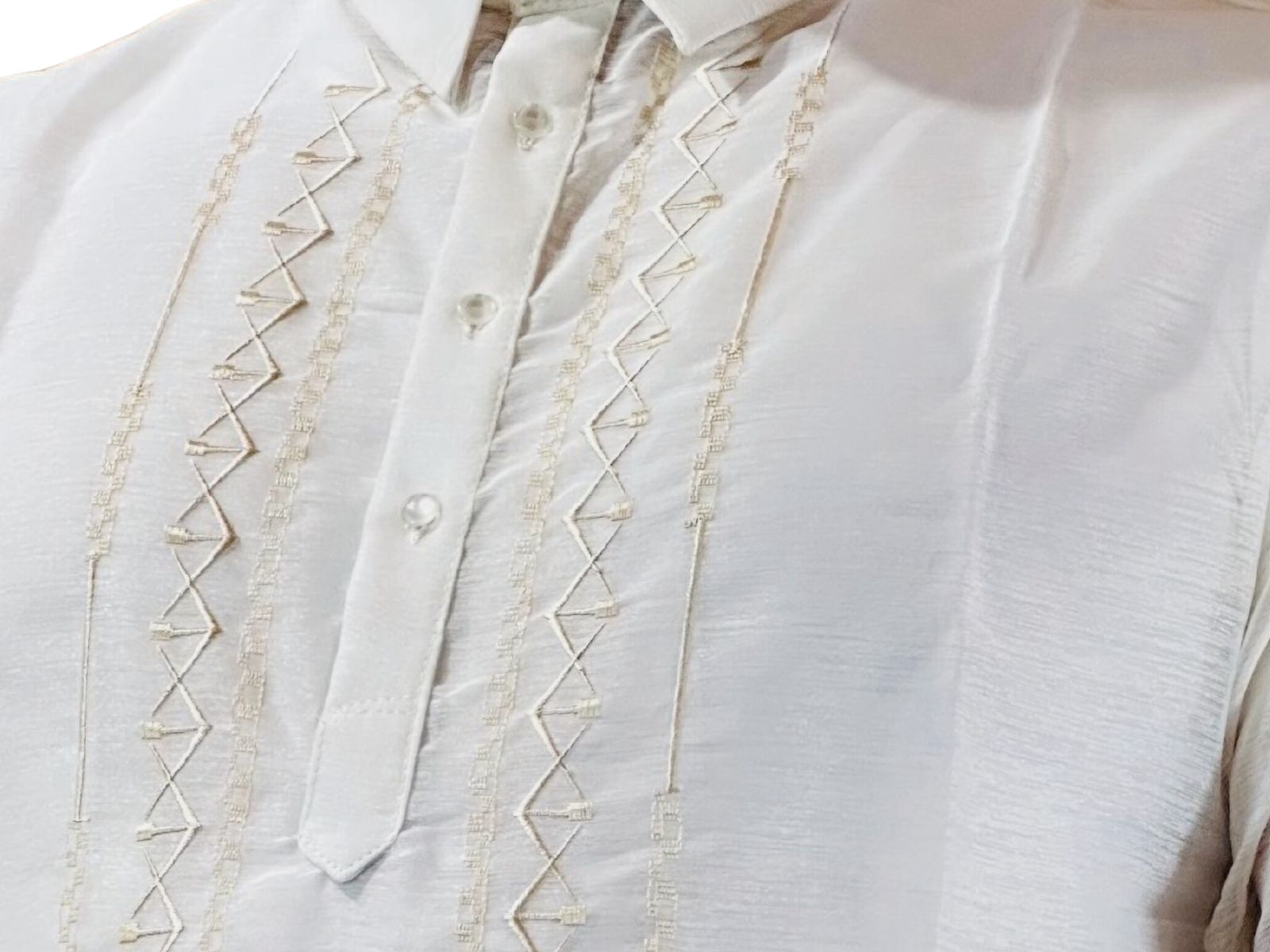
Jusilyn is a lightweight synthetic barong fabric with a fine crosshatch texture. It gives the soft, lightly sheer look of a traditional barong at an accessible price and with reliable supply. Jusilyn is its own fabric, and it’s what our two Jusilyn barongs are made of.
It’s a single layer, so the white camisa de chino beneath shows through faintly and softly, which is the traditional look, but it’s never so sheer that skin reads through it. The weave is consistent from piece to piece, so a six-groomsmen order ships looking like a coordinated set rather than six near-misses. At arm’s length, in a photograph, it reads as a classic sheer barong.
For an entourage of 6+ where per-piece price compounds, or for guest barongs where the customer wants to participate in the tradition without committing to a higher tier, jusilyn is the right answer. Photo-wise it shoots almost identically to organza in mid-distance shots, but with a softer fall that some grooms prefer for a more relaxed ceremony.
Drape: soft, falling
Weight: light
Breathability: high
Formality: wedding-appropriate
Care: hand wash and hang dry
Best for: large entourages, guests, budget-aware orders
When to choose it. Entourages of 6+ where the per-piece price compounds quickly. Guest barongs. Smaller, lower-key ceremonies where the groom-level texture of cocoon would feel overdressed.
Soft · washable · everyday
Cotton
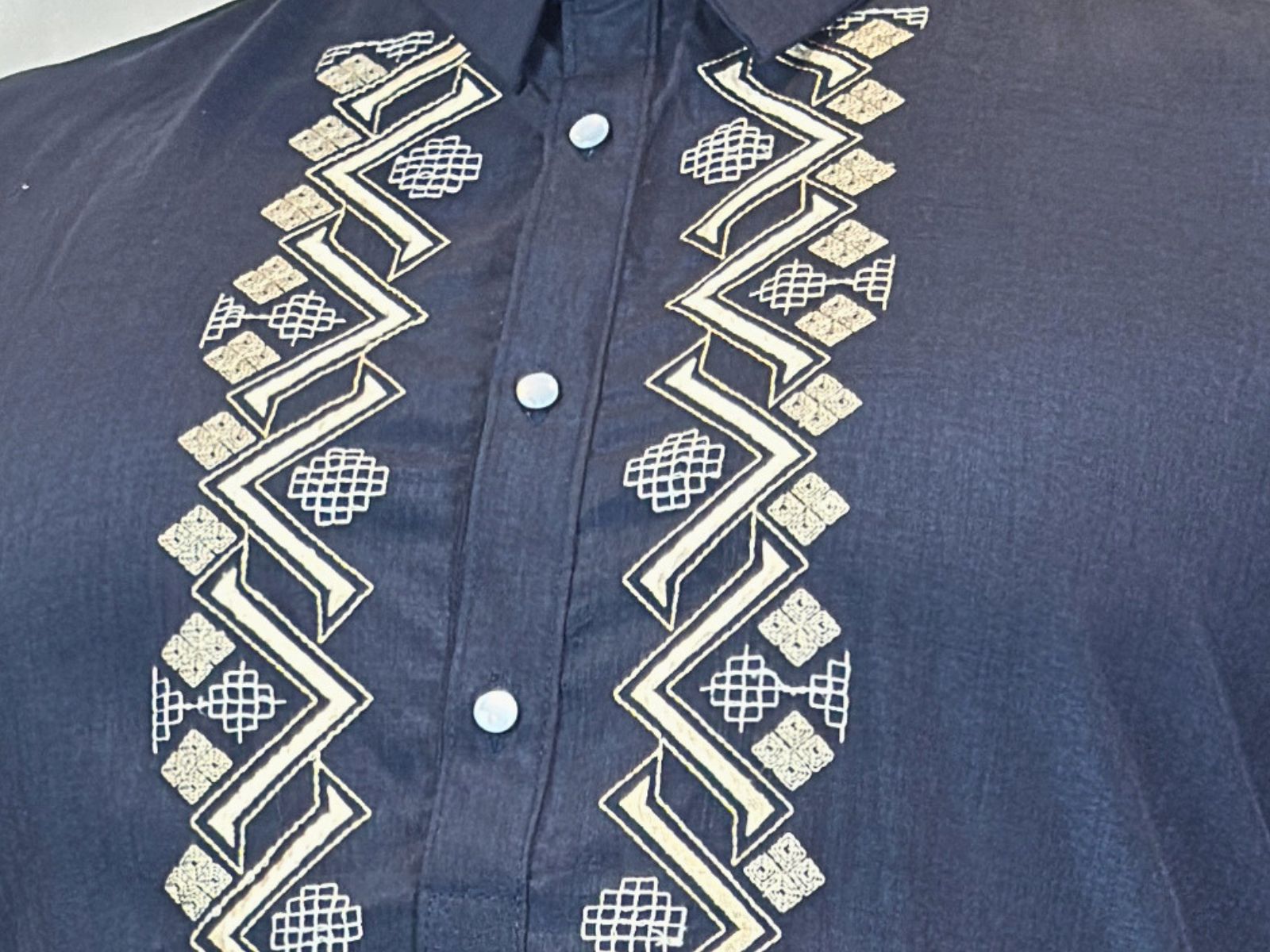
Cotton barongs sit one notch below the formal barong fabrics on the formality scale, and that’s the point. The fabric was originally a working-class adaptation: Filipino tailors who wanted to keep the silhouette of the formal barong but make it accessible for office, school, or daily wear. Today it occupies the same role: the barong you’d wear to work, to a casual dinner with the in-laws, to a weekend baptism where the rest of the family is in church-formal but not wedding-formal.
The construction is a tightly woven cotton or cotton-blend with a soft hand and a smooth surface that takes machine-embroidery cleanly. The weave is opaque, which means cotton barongs don’t need an undershirt the way the formal barongs traditionally do. That alone makes them more wearable as everyday clothing; you can throw one on and go. The trade-off is the absence of the formal weaves’ visual signal: cotton reads dressy but not ceremonial. It’s the same difference as the gap between an Oxford shirt and a tuxedo shirt.
It’s also the only barong fabric we ship that survives a regular laundry rotation. For office wear, casual dinners, summer events, humid climates, and any setting where the formal long-sleeve reads like overdressing, cotton is the right call. We also recommend it for travel: less to iron, faster to dry, easier to pack.
Drape: soft, relaxed
Weight: light to medium
Breathability: very high
Formality: smart-casual
Care: hand wash and hang dry
Best for: office, casual events, humid climates, travel
When to choose it. If you want a barong in your regular rotation — not just for the wedding-and-baptism circuit — cotton is the move. Reaches for office-appropriate without feeling like overdressing. Survives spilled coffee, the kid grabbing your sleeve, the long humid August day. Not what we’d recommend for the groom’s wedding photo, but exactly right for everything else.
At a glance
Side-by-side
| Fabric | Weight | Drape | Formality | Wedding role | Care |
|---|---|---|---|---|---|
| Organza | Light | Crisp | ★★★★ | Entourage default | Hand wash and hang dry |
| Cocoon | Light | Soft, textured | ★★★★★ | Groom’s choice | Hand wash and hang dry |
| Jusilyn | Light | Soft | ★★★★ | Budget entourage / guest | Hand wash and hang dry |
| Cotton | Light–Med | Relaxed | ★★ | Not for ceremony | Hand wash and hang dry |
Before you order
Frequently asked
Do you sell piña or jusi barongs?
No. Piña (pineapple-leaf fiber) and jusi are traditional Philippine barong fabrics, and we don’t sell either. Our barongs are polyester organza, with a few in Jusilyn, cocoon and cotton, all hand-embroidered by artisans in the Philippines. If you want a true piña barong, look for a specialist in the Philippines and expect to pay accordingly.
Can I mix fabrics across the wedding party?
Yes, and it’s the most-requested setup. Groom in cocoon, entourage in organza or Jusilyn. The visual hierarchy reads correctly in the photo without anyone having to point at the groom. Pure-cotton at a wedding reads understated; we’d reserve cotton for guests or save it for the casual events around the wedding (rehearsal dinner, post-wedding brunch).
Which fabric photographs best in low light?
Cocoon. Its soft, dry lustre and visible texture hold up under reception light, where smooth organza can read flat under tungsten or candlelight. For outdoor / daylight ceremonies, organza wins because the crispness reads clean in bright light and doesn’t show heat-fatigue.
Are any of these fabrics rated for cooler weather?
Not really: all four are warm-weather fabrics. For a cool indoor reception or a fall outdoor wedding, the right move is a coat barong (a structured top layer) over your barong rather than a heavier base fabric. See our Coat Barong styles.
How do I know what the fabric will actually feel like?
The fabric we ship is consistent across runs — what you’ll feel matches the descriptions above. If you’re committing to a high-spend order like a full wedding party, reach out via Wedding Inquiry and we can ship a fabric swatch before you commit.